Your questions.
Answered.
Public Schools First NC
-
I support adequately funding our public schools, teachers, and classrooms. However, increasing taxpayer funding without strong accountability is not enough. Before asking taxpayers for more, the Board of Education should provide the County Commissioners and the public with a clear, detailed accounting of how existing funds were spent and what results were achieved. Taxpayers deserve to know where every dollar goes, and resources should be directed to classrooms, teachers, and students—not unnecessary administrative growth. Additional funding should be tied to transparency, responsible stewardship, and improved student achievement.
-
Our teachers deserve fair, competitive wages, including additional pay for relevant advanced certifications and added responsibilities. However, teachers should not be used to justify repeated local tax increases—whether through property taxes or sales tax referendums—while too little funding reaches their paychecks and classrooms. Just as any business must present a clear plan and full accounting to secure funding, the school board should be required to provide a complete, itemized report to the county commissioners and taxpayers showing exactly how allocated funds were spent. Existing resources must prioritize teachers, classrooms, and students before additional administrative spending.
-
Student health, safety, and well-being are essential to learning, and schools should have access to nurses and student support professionals based on demonstrated local needs rather than simply meeting national staffing ratios. More importantly, these support services must always respect and uphold parental rights. Parents—not the government—are the primary decision-makers for their children. Support professionals should operate with transparency, keeping parents informed and involved in decisions affecting their child while focusing on student safety, academic success, and well-being. Any expansion of staffing should be accompanied by full public transparency, measurable results, and responsible management of taxpayer dollars.
-
Supporting early childhood readiness for eligible children is an important investment in our state's future. However, state funding should empower families by allowing them to choose the public, private, or faith-based early education program that best meets their child's needs. North Carolina should continue leveraging high-quality community providers rather than expanding a one-size-fits-all government system. Pre-K programs should protect parental choice, maintain fiscal discipline, operate with full transparency, and demonstrate clear, measurable educational outcomes before additional funding is considered.
-
Every child deserves access to a well-rounded education that includes art, music, physical education, and world languages. As someone who has spent much of my career working bilingually, I have seen firsthand how language skills open doors, strengthen communication, and create opportunities for students. These subjects foster creativity, critical thinking, physical wellness, cultural literacy, and skills essential for lifelong success. I support fully funding these classroom-based opportunities while ensuring resources are managed transparently, held to clear accountability standards, and directed to students and teachers rather than unnecessary administrative spending.
-
Students and teachers deserve high-quality, up-to-date textbooks, physical learning materials, digital resources, and classroom supplies without educators having to pay out of pocket. Funding decisions should be based on clear, transparent assessments of today’s actual classroom needs—not vague or outdated historical benchmarks. I support directing resources straight to teachers and students, while requiring price transparency, responsible purchasing, and full public accountability for how every dollar is spent.
-
Every child deserves the opportunity to meet high standards—not a different standard. I support programs that help struggling students improve based on their individual needs, not their race, income, ZIP code, or demographic group. Resources should go toward strong reading and math instruction, effective classroom support, and involving parents in their child’s education. Every student should be challenged, supported, and held to the same high expectations. My focus is on helping each child succeed without lowering the bar for anyone.
-
Teachers and schools should be evaluated fairly and transparently, using more than a single standardized test score. Student growth over time, classroom performance, parent engagement, and whether students are meeting key learning goals should all be considered. Evaluations should be based on clear, objective standards and used to support strong teaching while keeping the focus on student achievement.
-
I am running for school board because I believe every child deserves access to an excellent public school, and my goal is to make Guilford County Schools a district families choose because of its quality. At the same time, I support parental rights and school choice because a child’s educational opportunities should never be limited by ZIP code or family income. Parents—not the government—know which learning environment is the best fit for their child. Healthy competition can encourage all schools to improve. Ultimately, I want our public schools to be so strong that families choose them because they trust them—not because they have no other choice.
-
I do not support a moratorium on new charter schools. Stopping charter growth restricts parental choice and limits innovative learning options for families. Public charter schools are tuition-free options that parents turn to when their child needs a different learning environment. While charters must be held to clear academic standards and full financial transparency, they need to remain independently governed to preserve the flexibility that makes them unique. Placing charter schools under the control of local school boards defeats their purpose and undermines the independence families value. Our goal should be to expand access to high-quality schools, strengthen all public education, and preserve the right of parents to choose the setting that best meets their child’s needs.
As a first-generation Cuban American, my family's story has shaped how I view education, freedom, and the role of parents. I believe parents are a child's first and most important teacher, and schools exist to educate, support, and partner with families—not replace them. As a bilingual professional and volunteer with UNCG's Real World English program, I've worked with families from many different backgrounds and have found that they all want the same things, for themselves and their kids: safe schools, strong academics, excellent teachers, and the opportunity for their children to succeed. My priorities are simple: high expectations, academic excellence, fiscal responsibility, transparency, accountability, and meaningful parental involvement. Every child deserves the opportunity to meet high standards—not a different standard. My goal is to help make Guilford County Schools a district families choose because they trust it and where students are prepared to become knowledgeable, independent thinkers.
iVoterGuide
-
Strongly Agree - God is the author of life, and human life begins at conception.
-
The school's first role is to support the student by partnering with her parents, who should be informed and involved promptly. Schools should help her continue her education through accommodations, flexible classes, GCS Flex, or, if the family chooses, a homeschool co-op.
Rather than expanding school bureaucracy, schools should prioritize vetted private and nonprofit organizations already doing this work effectively, such as Save the Storks, which provides free ultrasounds and links women to prenatal care, adoption or parenting resources, and support after birth. These partnerships should be transparent, with board oversight to ensure accountability. This approach protects life, respects parents and uses public funds wisely. -
Government’s primary education responsibility is K–12, where funding should prioritize teacher pay, student safety, and academic fundamentals.
Any public funding for Pre-K or higher education should be limited, targeted, and tied to measurable results—not treated as an open-ended obligation. Taxpayers do not have unlimited resources. Every dollar should be tracked and managed carefully, with student learning taking priority over administrative growth. -
Strongly Agree
-
Regarding public schools, separation of church and state was never meant to erase faith. Schools cannot force religion on anyone or interfere with a person's right to practice one. No student should be required to pray, but students and staff should be free to express their faith on their own. I support a moment of silence so each student can pray, reflect, or simply sit quietly. Religious expression, clubs, and viewpoints should be treated under the same neutral rules as secular expression.
-
Strongly Agree
-
Strongly Agree - Consequences should be fair, consistent, and fit the behavior. This is not about punishing students for every mistake. It is about protecting students and teachers, maintaining order, and making sure one student’s behavior doesn't keep everyone else from learning.
-
Strongly Agree
-
Strongly Agree - Decisions about education should be made as close to the children as possible, right in our local communities. Parents and teachers know their students better than any bureaucrat in DC ever could. States can set basic requirements, but local school districts need the flexibility to meet their students’ needs, with input from parents and teachers. Keeping decisions local gives parents a stronger voice and makes decision-makers accountable to the communities they serve.
-
Strongly Agree
-
Strongly Agree - Parents should be able to choose the school that best fits their child. Public schools should not fear competition; they should earn families’ trust through strong academics, safe classrooms, and accountability. A child’s ZIP code should not determine the quality of education available to them.
-
I believe in one triune God—Father, Son, and Holy Spirit. Jesus Christ died for our sins, rose on the third day, and sits at the right hand of the Father. Salvation is a gift, and Jesus is the only way to the Father.
The Bible guides how I live and serve. Colossians 3:23-24 reminds me to do all my work as for the Lord, with excellence and integrity. I am an imperfect follower of Christ, but I want my actions to reflect His love by speaking truth, taking responsibility, serving others, and treating people with dignity and compassion. I answer first to God, while also recognizing my responsibility to the people who place their trust in me. My goal is to honor Him in how I serve. -
Strongly Agree
-
Strongly Agree
-
Strongly Agree
-
Strongly Agree
-
Strongly Disagree - An expert’s opinion that a book has literary value should not automatically exempt it from review. Materials should be evaluated under clear, board-approved standards based on law, grade level, educational relevance, and the work as a whole—not one person’s opinion. Parents deserve transparency, a formal review process, and the right to appeal. Consistent standards protect children without allowing personal preferences to control the library.
-
Strongly Disagree - We show ID for all kinds of everyday things. It makes no sense to treat voting—one of our most important civic responsibilities—as though verifying identity is unreasonable. Elections have consequences, and ineligible ballots undermine lawful votes. My parents fled Cuba, and both Cuba and Venezuela are perfect examples of why secure, fair, and honest elections matter. Requiring photo ID is a common-sense safeguard that helps protect every eligible voter.
-
Agree - I support allowing—not requiring—qualified faculty to carry, but a permit alone is not enough. It should require advanced and ongoing school-safety training, legal updates, thorough screening, secure handling and storage, and coordination with law enforcement. I would prefer hiring honorably discharged veterans or retired law enforcement officers who meet the same standards. Teachers should focus on teaching, with trained personnel serving as a last line of defense.
Piedmont Environmental Alliance
-
5 out of 5
(1 = Not Important, 5 = Very Important) -
I support building on successful partnerships like BackPack Beginnings and expanding access to school-based food pantries and weekend food programs where unmet needs exist. We can also strengthen farm-to-school partnerships and explore school gardens, indoor hydroponics, and cafeteria share programs that reduce waste while teaching students about science, agriculture, technology, and nutrition. Before asking taxpayers for more, the district should examine existing resources, pursue grants, and partner with local farmers, nonprofits, and businesses already doing this work. Parents and taxpayers should be able to see how public money is being spent and whether these programs are reaching the students and families who need them.
-
I would consider rooftop solar on a case-by-case basis rather than automatically approve it for every new school. Before voting yes, I would need to see the full financial picture: the cost to purchase, finance, and maintain the system; the remaining life of the roof; available grants and federal Direct Pay reimbursements; projected energy savings; and how long it would take to pay for itself. The analysis must also include the eventual cost of removing and responsibly recycling or disposing of the panels and restoring the roof. We should not commit funds without a responsible end-of-life plan. I will support solar when the numbers show a clear long-term benefit for students and local taxpayers. I will not commit limited education dollars to a project when the numbers do not add up or leave future taxpayers to pick up the bill.
-
Guilford County Schools has already incorporated energy-efficient design, HVAC improvements, daylighting, insulation, and energy monitoring into some of its schools. I would begin by looking at how consistently those practices are being used and whether completed projects are producing the savings that were promised. I would continue proven measures such as preventive HVAC maintenance, efficient lighting and controls, better insulation, sealing air leaks, and targeted window treatments where energy audits show they would save money. GCS should publicly report each project’s projected and actual energy use, costs, and savings. If something is not performing as expected, we need to find out why and correct it. Parents and taxpayers deserve to know where their money went and whether it produced the promised results. Before approving new spending, I would want to see the need, the expected payback period, and the benefit to students and taxpayers.
-
4 out of 5
(1 = Not Important, 5 = Very Important)
-
I’m willing to consider funding electric activity buses when it works reliably for students and makes financial sense for taxpayers, but first I want to see how the electric buses GCS is already adding to its fleet actually perform. Electric buses cost considerably more upfront, and charging equipment, electrical upgrades, specialized tools, and driver and technician training add to that cost. Before using local taxpayer dollars, I would expect Guilford County Schools to publicly show the full cost, what grants or manufacturers will cover, and what local taxpayers will pay. Electric buses may save money on fuel and routine maintenance, but we need to know whether those savings justify the total investment.
Activity buses travel farther and follow less predictable schedules than regular school buses. Before voting for them, I would want to know their real-world range when fully loaded with students and equipment, including when the heat or air conditioning is running, and whether compatible charging would be available along longer routes or at their destinations. GCS should also confirm that qualified towing and recovery services are available both locally and along those routes, and that local emergency responders are trained to handle the specific high-voltage bus model in the event of an accident. Maintenance, battery recycling, parts availability, and warranty service must also be included in the decision.
-
3 out of 5
(1 = Not Important, 5 = Very Important)
-
4 out of 5
(1 = Not Important, 5 = Very Important)
-
I want to begin by looking at how much waste each school produces, what it already recycles or reuses, and what services our local governments and community partners can provide. From there, we can expand practical, common-sense steps like clearly marked recycling bins, cafeteria share tables, reducing unnecessary single-use plastics, and composting appropriate food scraps and clean, uncoated cardboard from school deliveries for use in school gardens. We should also compare the long-term cost of disposable cafeteria items with reusable trays and silverware at schools that already have the equipment to wash them.These efforts can also give students hands-on lessons in science, agriculture, and conservation. I would start with schools where the partnerships and equipment are already in place, track how much waste we divert, and measure the costs. Reducing waste is worthwhile, but parents and taxpayers deserve to know whether these programs are working and whether their money is being used responsibly.
Enlace Latino
-
I am a first-generation Cuban American, wife, and mother of three and I have lived in the district I am seeking to represent for more than 30 years. I currently work as a patient referral coordinator and am also the co-owner and bookkeeper of Vinny’s Auto Service in High Point, our family business for more than 26 years.
I returned to college in 2016 and graduated summa cum laude from UNC Greensboro. My experience in education includes homeschooling two of our three children, volunteering in public schools, teaching at a homeschool co-op, and volunteering as an ESL teaching assistant through UNCG’s Real World English program. I also previously served on the City of High Point Human Relations Commission.
-
I decided to run because students should not be passed to the next grade without learning the skills they need. When our oldest daughter failed her sixth-grade End-of-Grade (EOG) test, the school promoted her to seventh grade anyway. That was a turning point for our family. I pulled her out and homeschooled her, and when she later returned to public high school, she graduated early with honors. That experience taught me how important it is for schools to keep parents informed, maintain open communication throughout the school year, catch academic problems early, and help children before they fall further behind.
I want schools to partner with parents in their children’s education. As a bilingual, first-generation Cuban American, I can communicate directly with parents who are more comfortable speaking Spanish and make sure their questions and concerns are heard—not lost in translation. Every family deserves a voice at the table, regardless of which language they speak at home.
Through raising a family, homeschooling, volunteering in public schools, working in healthcare, and running a small business, I have learned how to ask tough questions, manage money responsibly, and stand up for what is best for students, families, and taxpayers.
-
The three pillars of my campaign—Students, Families, and Accountability—guide how I would address the main challenges facing Guilford County Schools today.
Students: We must ensure students are academically prepared before moving to the next grade. My family experienced this firsthand when our oldest daughter failed her sixth-grade End-of-Grade (EOG) test, and the school promoted her to seventh grade anyway. Schools must identify learning gaps early, communicate regularly with parents, and provide intervention before students fall further behind. Teachers also need the freedom to teach, and students need safe, orderly classrooms where learning comes first.
Families: We need to strengthen the partnership between schools and parents. Families should receive clear, timely information and have a meaningful role in decisions affecting their children. Building strong, two-way communication ensures parents from every background have a voice in our school system.
Accountability: Taxpayers deserve full transparency about how their money is spent and whether programs are producing results. I support clear line-item reporting, measurable goals, and directing as much funding as possible toward classrooms, teachers, and student resources.
-
If elected, my priority is returning our school system’s focus to its core mission: educating students. That means identifying learning gaps early, giving teachers the support and freedom to teach, keeping classrooms safe and orderly, and treating parents as real partners in education.
We also need an honest review of how money is being spent. Teachers deserve better pay, and we can make that a priority by cutting waste, phasing out programs that do not produce results, and scaling back central administrative spending. Smarter budgeting would put more dollars directly into classrooms and teacher pay without constantly asking taxpayers for more.
I will measure student growth in reading and math in more than one way, while also reviewing school safety and discipline data and listening directly to parents and teachers. I will look at whether teacher pay improved, whether more funding reached classrooms, and whether the public could easily understand the budget. Ultimately, I will consider my term successful if more students graduate having mastered core reading and math skills, families feel heard, teachers feel valued and better paid, and taxpayers have clear proof that their dollars are being used responsibly.
-
I'd begin by listening to Latino parents and students rather than assuming every family has the same needs or concerns. As a bilingual, first-generation Cuban American who has volunteered as an ESL teaching assistant and served as an interpreter for health department maternal care programs, I understand the importance of clear communication when navigating public systems and staying involved in a child’s education.
As a board member, I would support Guilford County Schools’ continued efforts to provide Spanish-language information and qualified interpretation to Latino families who need them. I would also want to know whether families are aware of these resources and whether the services are working effectively. The same standard of language access should apply to families who speak other languages.
I would also be available as a language bridge for Spanish-speaking parents throughout Guilford County. When needed, I could help them communicate their concerns and connect them with their own district representative or the appropriate school staff. This would give families another way to be heard while respecting the responsibilities of each board member.
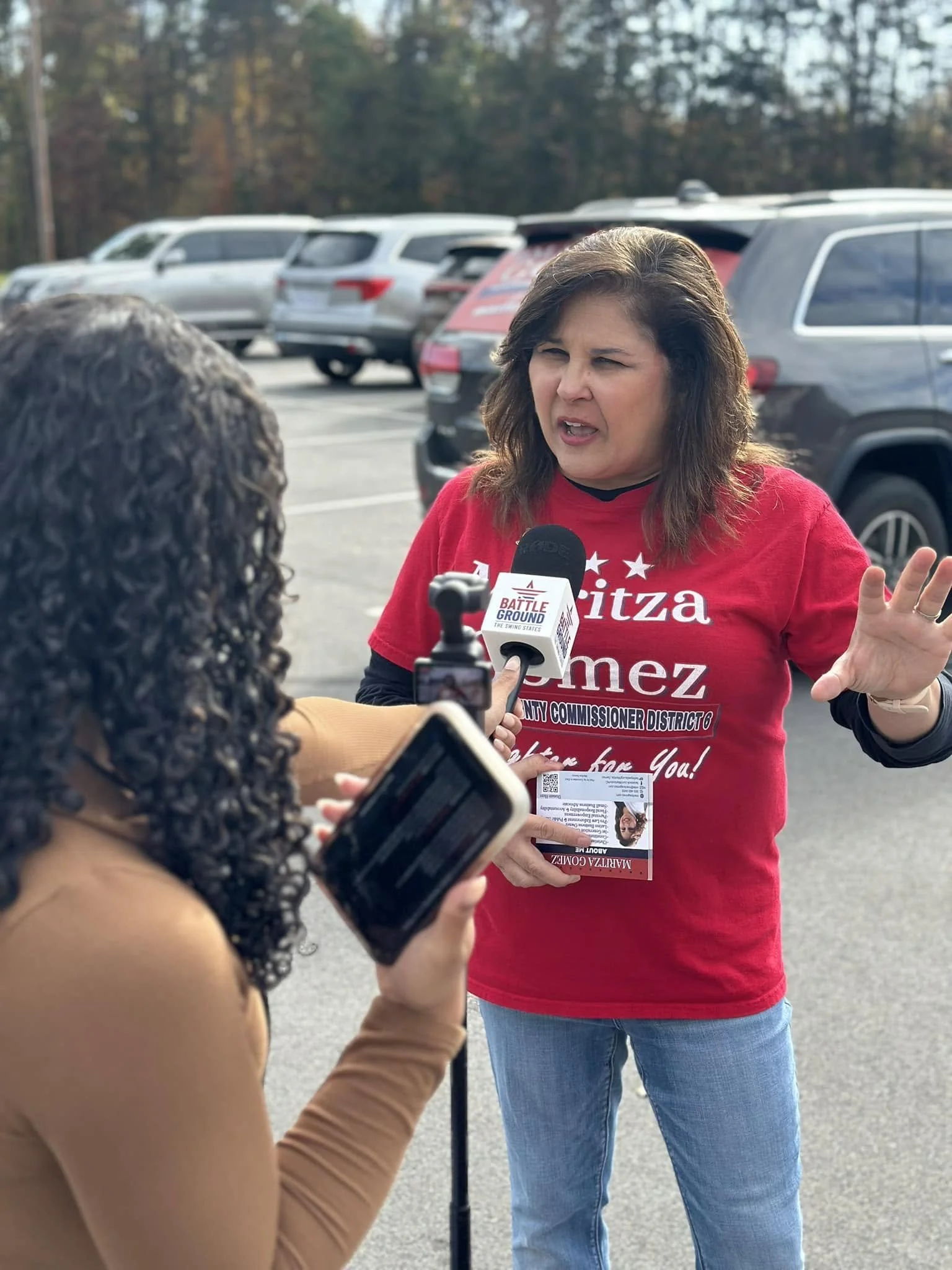
Maritza Gomez is a first-generation Cuban American, wife, mother of three, and longtime District 6 resident. She is bilingual and works in healthcare as a patient referral coordinator while also serving as co-owner and bookkeeper of Vinny’s Auto Service in High Point, her family’s business for more than 26 years. Maritza returned to college in 2016 and graduated summa cum laude from UNC Greensboro. Her experience in education includes homeschooling two of her children, volunteering in public schools, teaching at a homeschool co-op, and serving as an ESL teaching assistant. She also previously served on the City of High Point Human Relations Commission. Maritza is running for the Guilford County Board of Education to promote strong academics, safe classrooms, parental involvement, responsible spending, and greater accountability.
League of Women Voters
-
I bring experience as a parent and former High Point Human Relations commissioner. For over 26 years, I’ve helped run our family business as owner and bookkeeper, reviewing expenses and making careful spending decisions. As a bilingual patient referral coordinator, I help patients navigate referrals and insurance, explain what to expect, and ease their concerns. As a patient, I learned how much clear communication matters. I returned to college as an adult and graduated summa cum laude from UNC Greensboro. I’ve homeschooled two of my children, volunteered in public schools, taught at a homeschool co-op, and served as an ESL teaching assistant. These experiences taught me to listen, follow through, and persist until I get answers.
-
A school board member’s first responsibility is to ensure students receive a strong education in core subjects in safe, orderly schools. Board members should support teachers, respect parents as partners, and keep families and taxpayers informed. They must review spending carefully, set measurable academic goals, and hold district leadership accountable. Every decision should be judged by how well it helps students learn and prepares them for life after graduation.
I want schools to partner with parents in their children’s education. As a bilingual, first-generation Cuban American, I can communicate directly with parents who are more comfortable speaking Spanish and make sure their questions and concerns are heard—not lost in translation. Every family deserves a voice at the table, regardless of which language they speak at home.
Through raising a family, homeschooling, volunteering in public schools, working in healthcare, and running a small business, I have learned how to ask tough questions, manage money responsibly, and stand up for what is best for students, families, and taxpayers.
-
Guilford County Schools’ most urgent needs are strong classroom instruction, student safety, effective special education, and recruiting and retaining qualified teachers. That means competitive pay and timely access to classroom funds and supplies. I would press for these needs to come first in budget discussions, ask whether funds are reaching classrooms on time, and examine administrative spending for potential savings.
-
To recruit and retain qualified teachers, I would advocate for competitive pay, safe and orderly classrooms, and reliable access to supplies. Teachers should also have the freedom to adjust instruction to meet their students’ needs, without unnecessary paperwork or delays in receiving classroom funds. I would listen to teachers about why they stay or leave, bring those concerns to the board, and look for savings that could be directed toward classrooms and compensation.
-
Pre-K is an important way to help children build the skills they need for kindergarten and address learning gaps early. Families should be able to choose a quality public, private, or faith-based program that best fits their child’s needs. I support working with educators and community providers, being transparent about costs, and measuring whether programs improve kindergarten readiness.